
Overview
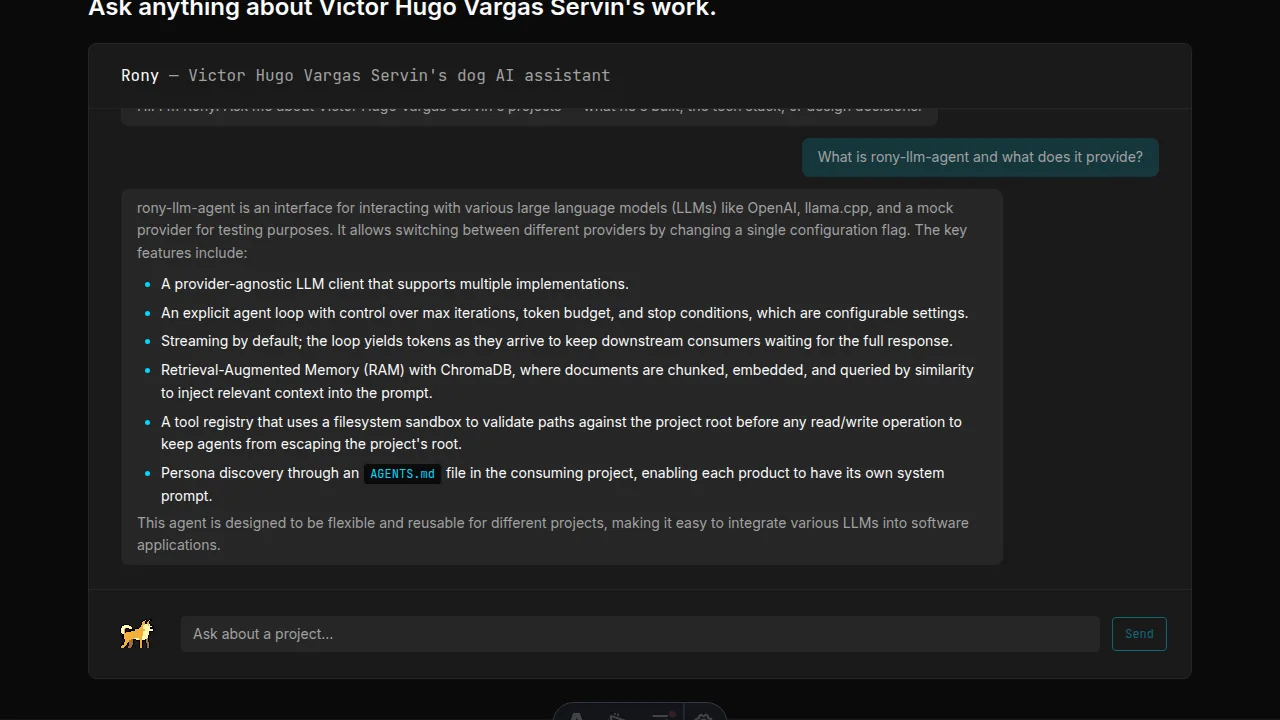
rony-llm-agent is the reusable core behind products such as rony-chat-bot and rony-harness. It owns the generic agent behavior — provider abstraction, orchestration, memory, personas, tools, and sandboxing — while each product chooses its UI, deployment, and configuration.
It is intentionally not a CLI, HTTP server, or opinionated product. Consumers use the public Go interfaces and compose only the adapters they need.
Execution model
The agent loop is streaming-first and explicit about its limits. A run adds the user input to history, asks the configured LLM for a response, executes any requested tools, appends their results, and continues until the model finishes or a guardrail stops the run.
iter.Seq2exposes generated chunks without callback plumbing.MaxIters, token budgets, timeouts, and stop conditions are configuration rather than hidden constants.- A mock LLM client makes every iteration deterministic in unit tests without spending real tokens.
- The response reports content, tool calls, iteration count, duration, and token usage for downstream observability.
Architecture
The library follows ports-and-adapters boundaries so products do not couple their domain logic to a provider SDK or storage implementation:
| Package | Responsibility |
|---|---|
pkg/agent |
Iterative loop, streaming, termination, approvals, and sub-agent orchestration. |
pkg/llm |
Provider-neutral client interface, message types, capabilities, and streaming chunks. |
pkg/rag |
Retrieval-augmented memory, embeddings, semantic search, and vector-store boundaries. |
pkg/persona |
System prompt assembly, YAML personas, and AGENTS.md discovery. |
pkg/tools |
JSON Schema tools, permissions, registry, results, and execution contracts. |
pkg/config |
YAML loading and hierarchical configuration precedence. |
Ports define the behavior the core needs; adapters implement OpenAI, Anthropic, Ollama, llama.cpp, ChromaDB, and embedding backends around those contracts. Swapping an adapter does not change the agent loop.
Safety boundaries
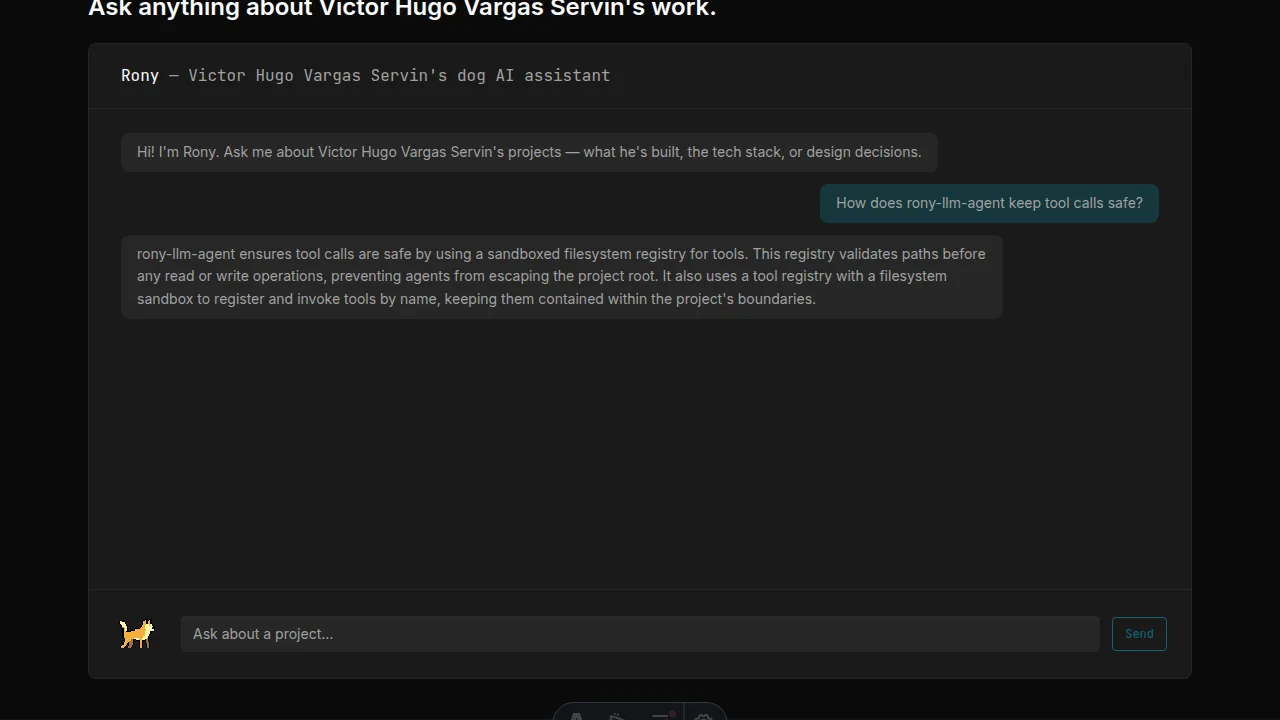
- Filesystem sandbox — tool paths are validated against the consumer’s project root with
os.Root, keeping reads and writes inside the allowed workspace. - Permission-aware tools — tools carry
Allow,Ask, orDenypolicies so a product can require approval before consequential operations. - Bounded execution — iteration, token, output-size, timeout, and cancellation limits prevent one model response from consuming an unbounded run.
- Deterministic tests — mock providers and embedding clients let the security and termination rules be tested without external services.
- Persona isolation — the consuming project’s
AGENTS.mdcontributes its own instructions, so the same runtime can serve different products without sharing product-specific behavior.
The library provides the safety primitives; the consuming application still owns its approval UX and deployment permissions.
Product adapters
The same runtime is used in different contexts:
| Consumer | What it adds |
|---|---|
| rony-chat-bot | HTTP/SSE transport, persistent conversations, portfolio retrieval, and a drop-in web widget. |
| Rony Harness | Terminal UI, local/cloud model selection, real software tools, approvals, and persistent sessions. |
Rony Harness is a concrete consumer of the runtime: the same core handles model selection, tool execution, approvals, and the resulting files while the TUI owns the interaction surface.
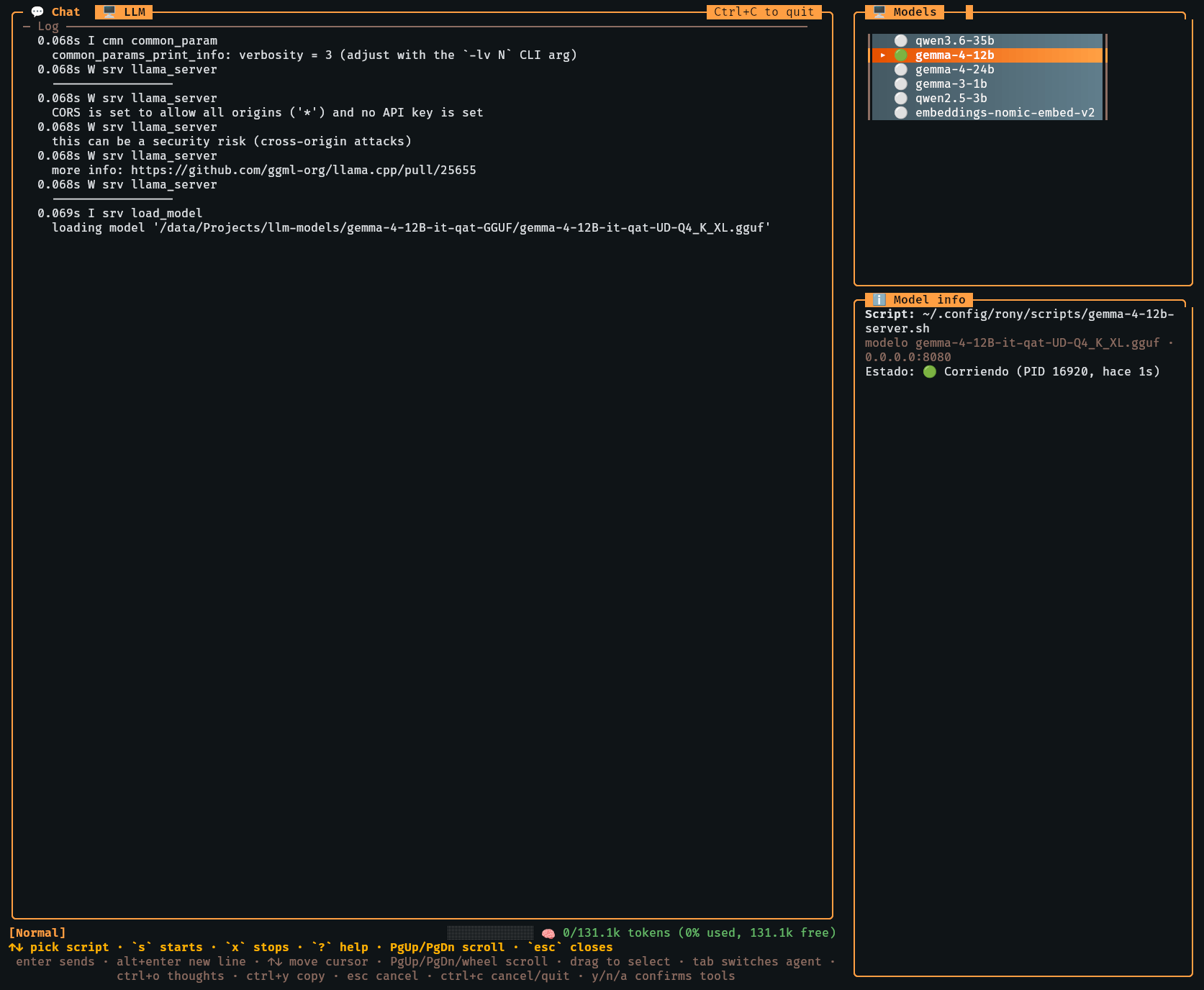
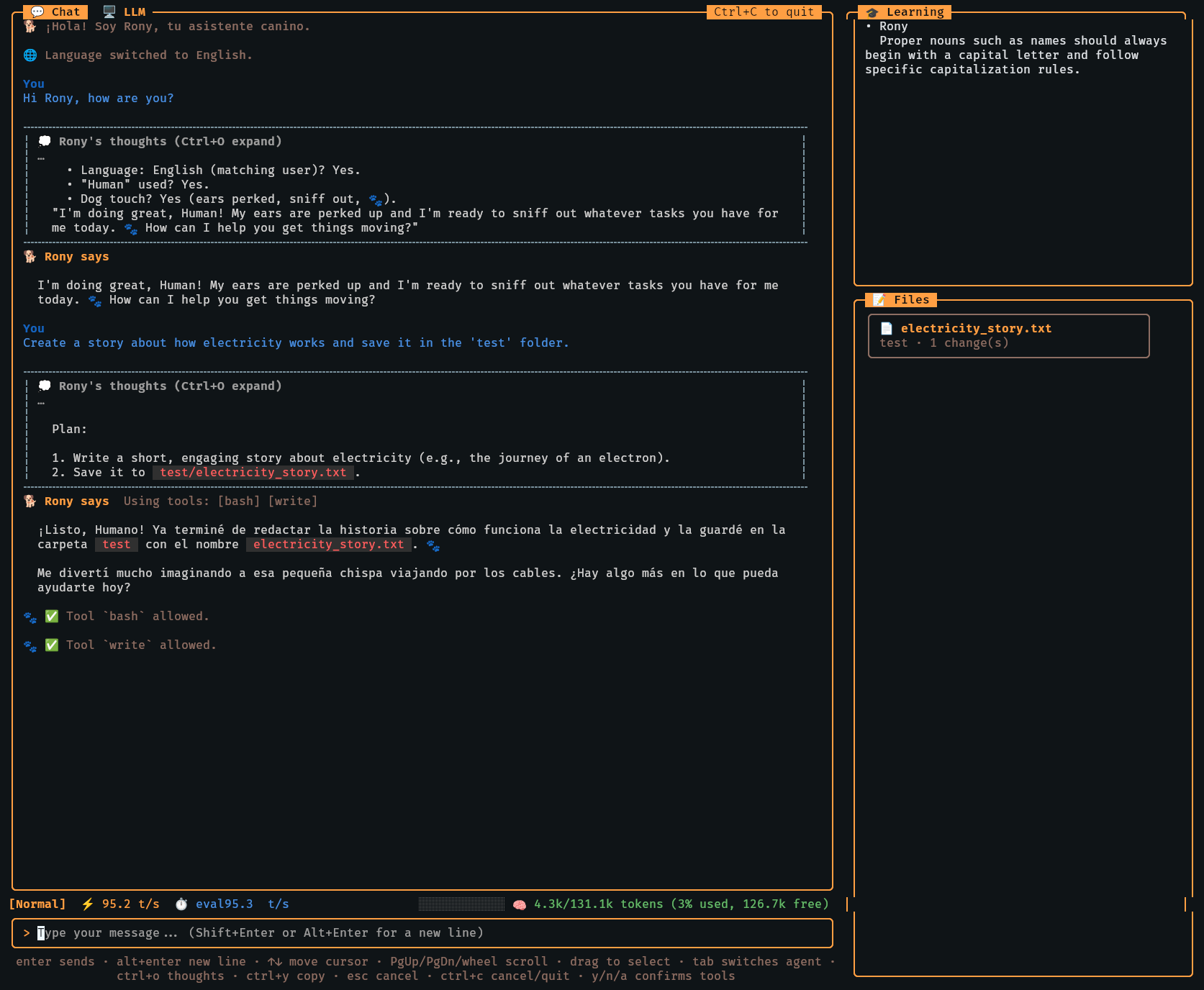
This separation keeps the core small and reusable while allowing each product to expose the right interaction model for its audience.
Files of note
pkg/agent/— loop orchestration, streaming, iteration limits, and sub-agents.pkg/llm/— public provider interface and model-neutral request/response types.pkg/rag/— memory and retrieval abstractions.pkg/persona/— persona loading andAGENTS.mddiscovery.pkg/tools/— registry, permissions, tool results, and sandbox integration.docs/architecture.md— ports, adapters, core interfaces, and the execution algorithm.